The Need for a Domestically Developed DNA Sequencer
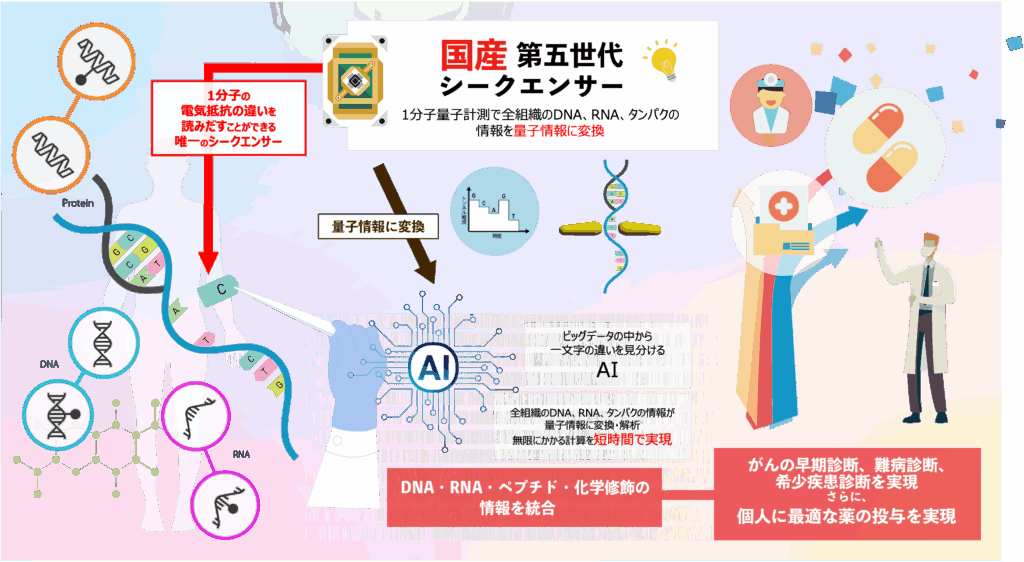
DNA sequencers have become indispensable tools across a wide range of fields, including genetic diagnostics, forensic investigations, and genetic testing in cancer treatment. However, all DNA sequencers currently used domestically are manufactured overseas. As a result, not only does a vast amount of public funding flow out of the country, but there is also a risk that sensitive genomic data of citizens may be transferred abroad. Furthermore, if overseas supply chains were disrupted, it could lead to a situation in which cutting-edge medical care can no longer be provided to the public.
To address these challenges, we are developing a domestically produced DNA sequencer. Our goal is to bring this technology to market as quickly as possible and contribute to national security and the advancement of healthcare.
The Innovative Nature of the “Biomolecular Sequencer” We Are Developing
What we are developing is not simply a conventional DNA sequencer. We call it a “biomolecular sequencer”, as it is capable of decoding not only DNA sequences but also RNA nucleotide sequences and amino acid sequences of peptides. In addition, because it can directly analyze chemically modified molecules that indicate disease states (epigenetic information), it enables advanced analyses such as:
Epigenetic analysis
Epitranscriptomic analysis
Post-translational modification analysis
Moreover, this instrument can count individual molecules one by one, allowing precise quantification of how much specific DNA or RNA is present. This technology, which enables comprehensive analysis of DNA, RNA, and peptides, goes beyond conventional diagnostics and serves as a key to unraveling the fundamental mechanisms of life itself.
A New Challenge in Cancer Therapy
While DNA sequencers have made cancer panel testing possible, we are looking beyond this current stage. We are now working to apply our technology to cancer immunotherapy, which represents the forefront of cancer treatment.
On the surface of cancer cells, there exist cancer-specific markers known as “cancer antigen peptides.” By isolating and amplifying these peptides and administering them to patients, T cells can be stimulated to attack cancer cells. However, cancer antigen peptides are present only in extremely small quantities, and efficient methods for identifying them have not yet been established.
Using the biomolecular sequencer currently under development, we are conducting research aimed at efficiently discovering these trace amounts of cancer antigen peptides. Once this technology is established, the biomolecular sequencer will evolve beyond a diagnostic instrument into a drug discovery tool capable of enabling new therapeutic strategies and the development of novel medicines.