“Is there life elsewhere in the universe?”—this is one of the great questions humanity has pondered for centuries. Today, we are advancing the development of groundbreaking technologies to tackle this profound mystery.
Searching for Traces of Life with New Technologies
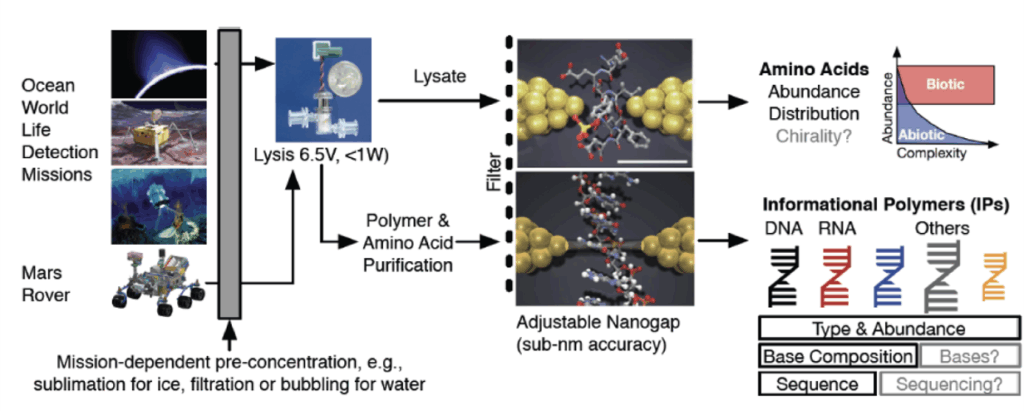
The surfaces of the Moon and Mars are exposed to intense cosmic radiation and extreme temperature fluctuations between day and night, making it highly unlikely that biological DNA or proteins could remain intact. However, traces of life may persist in different forms. Here, amino acids play a key role. Amino acids exist as two optical isomers—L- and D-forms—which are mirror images of each other. On Earth, almost all amino acids that constitute living organisms are of the L-form. If amino acids were discovered on the Moon or Mars and found to be biased toward the L-form, this would represent strong evidence that life once existed there.
On-site “Single-Molecule Measurement” and AI
To detect these subtle biases in amino acids, we are developing a system that combines ultra-high-sensitivity single-molecule measurement technology with AI. This system is designed to operate under the harsh conditions of the Moon and Mars, enabling direct, on-site analysis of trace amounts of molecules, while AI analyzes potential signatures of life. Since 2018, with the cooperation of NASA, we have been working toward practical implementation of this technology through a joint project with the Massachusetts Institute of Technology (MIT) and Harvard University. To date, we have successfully achieved single-molecule measurements of amino acids on the Moon, on Mars, and in microgravity environments. This cutting-edge technology may one day provide an answer to the question, “Is there life elsewhere in the universe?”