>CHALLENGE
Confronting the Limits of Semiconductors and the Challenge of Molecular Devices
Semiconductor devices are indispensable components of virtually all electronic equipment used in our daily lives. To date, semiconductor technology has followed Moore’s law, achieving continuous miniaturization and performance enhancement. However, the limits of further miniaturization are now becoming increasingly evident.
>BARRIER
The Barrier to Semiconductor Miniaturization
Each further step toward miniaturization requires the construction of new fabrication facilities at enormous cost. Moreover, as device dimensions approach the scale of a single atom, not only do manufacturing costs rise dramatically, but physical limitations are also expected to prevent stable device operation. In this way, semiconductor miniaturization is rapidly approaching its limits from both economic and physical perspectives.
>NEXT OPTION
A Next-Generation Alternative: Molecular Devices
Against this backdrop, molecular devices have attracted significant attention. These next-generation devices utilize a single molecule with a size of approximately 1 nanometer (nm) and offer the potential for low-cost fabrication.
>APPROACH
Technical Challenges and Our Approach
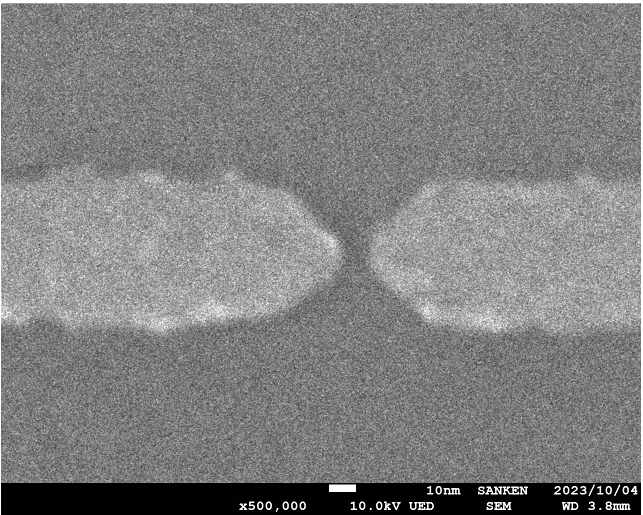
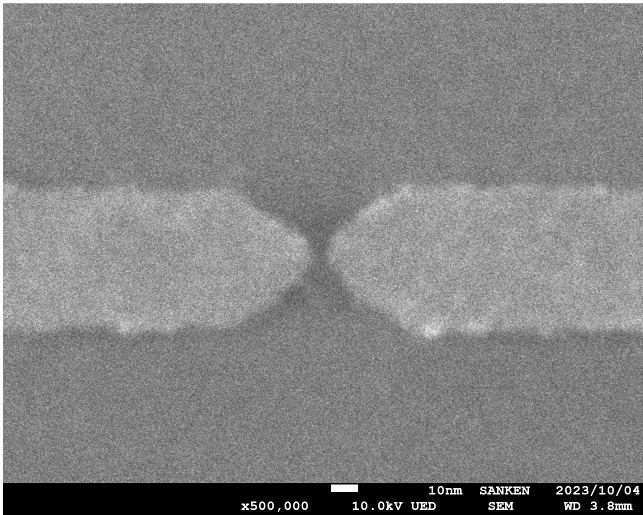
Realizing molecular devices requires technologies capable of fabricating electrodes with extremely narrow gaps below 10 nm (nanogaps) in a stable and highly precise manner. Such technologies have not yet been fully established.
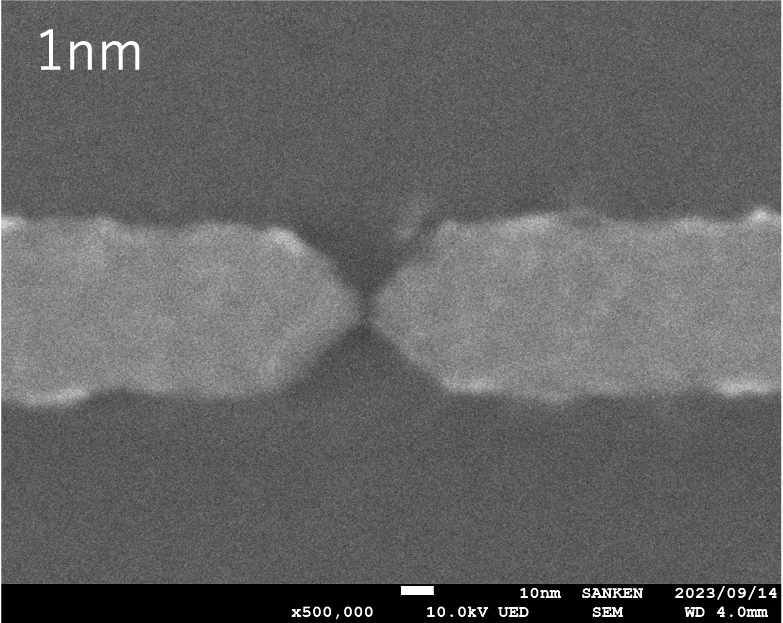
Since 2004, we have been conducting research and development on nanogap electrodes using electron-beam lithography. Through collaboration with industry partners, we have improved instrument performance and refined beam correction and deposition techniques, enabling us to fabricate nanogap electrodes with gaps below 10 nm on silicon substrates.
Furthermore, we are now challenging ourselves to develop technologies that allow the mass production of 1-nm nanogap electrodes with even higher reproducibility, precision, and fabrication yield.