Turning Serendipity into Certainty: Transforming the Future of Chemistry
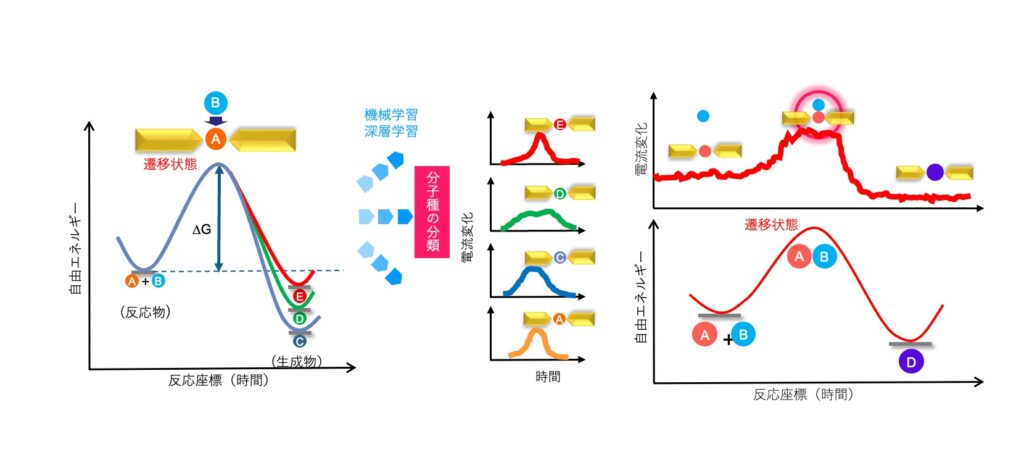
In your student days, you probably learned simple chemical reactions such as “A + B → C.” However, in real chemical reactions, not only the desired product C but also unintended products such as D and E are generated in small amounts. In most cases, these byproducts are overlooked and discarded. Yet, when we look back at history, world-changing discoveries have often emerged from these D and E species that were once “destined to be discarded.” This phenomenon is known as serendipity—unexpected and fortunate discoveries—and it is regarded with the highest respect in the scientific community.
Single-Molecule Measurement and AI as the Key
What if we could intentionally induce serendipity? We are developing technologies to turn accidental discoveries into inevitable ones. This is achieved by combining single-molecule measurement using nanogaps with AI. With this approach, it becomes possible to detect and analyze trace amounts of byproducts such as D and E at the molecular level as they emerge during chemical reactions.
A Chemist’s Dream: Capturing the Moment of Reaction
Chemical reactions are believed to proceed through an unstable intermediate known as the “transition state,” where substances transform at the very moment of reaction. However, no one has yet directly observed this transition state at the single-molecule level—this has long been a dream of chemists. To realize this dream, we are developing technologies capable of measuring ultrafast timescales such as picoseconds (one trillionth of a second) and femtoseconds (one quadrillionth of a second), aiming to observe chemical reactions at the molecular level as they occur. Furthermore, by controlling the directions of molecular collisions during observation, we are beginning to uncover entirely new bonding modes that could never be seen in conventional flask-based reactions. We believe this research has the potential to create unprecedented new materials and to contribute solutions to global challenges.